Is Bernie an Oligarch? Follow the $26 Billion Duck
Q: Why start with a duck?
A: Because of the old saying — if it looks like a duck and walks like a duck, it’s probably a duck. It’s a simple way to test whether something is what it appears to be.
Q: How does that apply to Bernie Sanders?
A: For years, Bernie has positioned himself as the defender of the poor and middle class — the voice against billionaires, big pharma, and big insurance. But sometimes actions and reactions tell a more complicated story.
The Shutdown and the $26 Billion Question
Q: What happened with the new budget vote?
A: The Senate passed a compromise budget to reopen the government after weeks of shutdown. Most people saw it as progress. But Bernie Sanders voted against it and called it a mistake.
Q: Why did Bernie oppose reopening the government?
A: His objection was that the bill didn’t include an extension for Affordable Care Act subsidies — a package worth about $26 billion. He argued that without those subsidies, health insurance premiums would rise.
Q: Where does that $26 billion actually go?
A: The subsidies don’t go directly to citizens. They are paid through the insurance companies to offset policy costs. So while individuals benefit indirectly from lower monthly premiums, the actual funds go to the insurers themselves.
The Contradiction
Q: Isn’t Bernie known for criticizing those same insurance companies?
A: Yes. He’s repeatedly said that health insurers make “tens of billions” in profits each year and that they represent part of America’s oligarchic system. That’s why his strong opposition to a bill that didn’t give them another $26 billion raises eyebrows.
Q: Why is that considered controversial?
A: Because it appears inconsistent — railing against corporate profit one day and fighting to keep billions flowing into that same system the next. It’s less about accusation and more about asking whether his reaction fits his own message.
Looking Deeper
Q: What exactly is an oligarch?
A: The term refers to a small group of powerful individuals or corporations controlling a nation’s wealth and influence. Bernie has used it to describe billionaires and corporate executives who shape policy from behind the scenes.
Q: So why even ask if Bernie fits that label?
A: Because influence isn’t always about net worth — it’s about alignment. When a politician’s decisions end up protecting the same corporate systems they publicly oppose, it’s fair to ask if the lines have blurred.
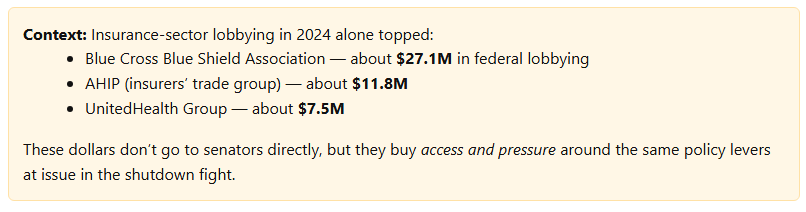
Follow the Money
Q: Has Bernie ever received money connected to the insurance industry?
A: According to publicly available campaign-finance records, individuals and PACs affiliated with the insurance industry have contributed to Bernie Sanders’ campaigns over the years — about $2.1 million since 1990, including roughly $95 thousand in the most recent cycle. These are legal, disclosed donations, not personal payments or “kickbacks.” The question for voters is whether accepting that level of industry-linked support aligns with his message about fighting corporate influence.
Q: What should the public take away from this?
A: Always follow the money — not the slogans. Look at where the dollars go, who benefits, and who gets upset when the flow stops.
Q: So what’s the verdict?
A: There isn’t one. Readers can decide for themselves whether Bernie’s outrage is consistent with his principles — or whether this is another case of Washington saying one thing and doing another.
This post is commentary and opinion based on publicly available information. Readers are encouraged to verify sources, review Senate records, and form their own conclusions.