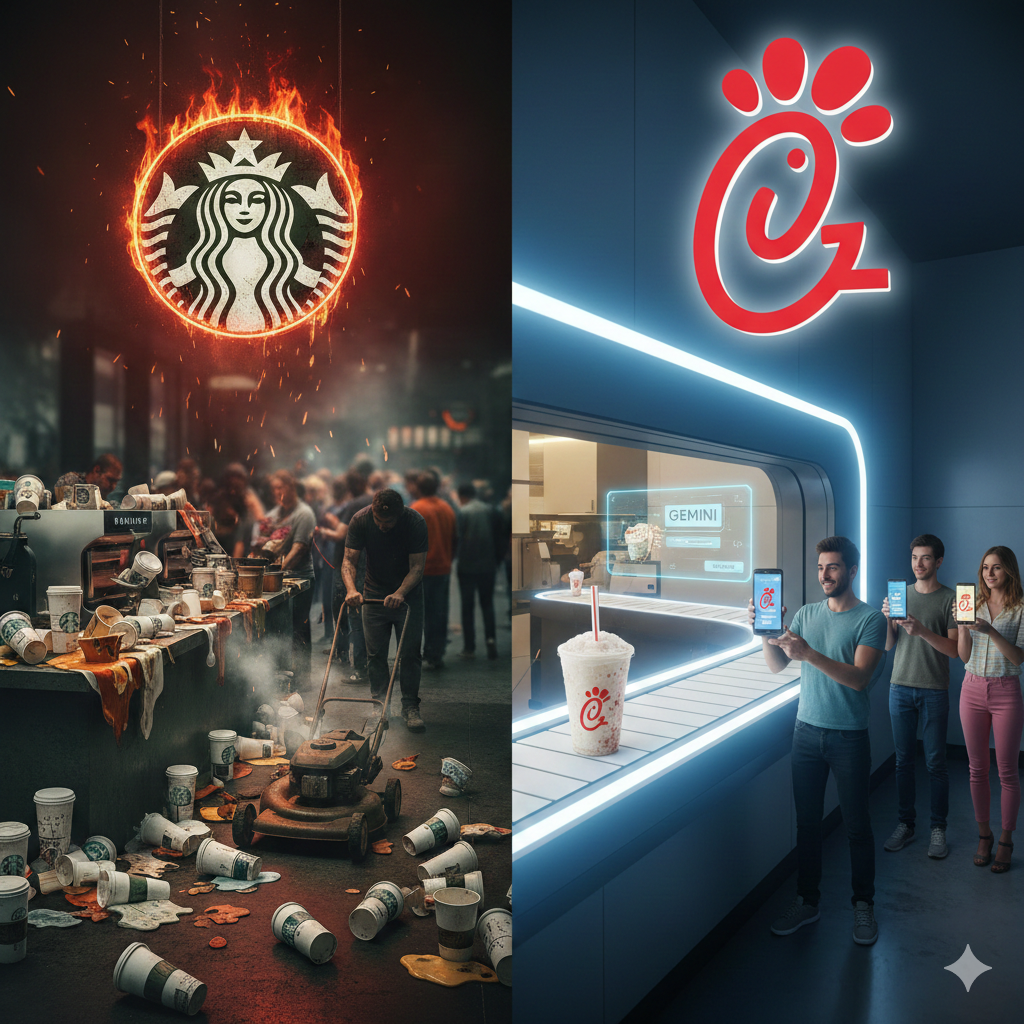
If you’ve stepped into a drive-thru lately, you know that the friction is becoming unbearable. It doesn’t matter if you are selling fried chicken, designer mugs, or high-level consulting services; if the “order to delivery” pipeline is clogged, you are losing money. I’ve spent years looking at how businesses fail, and usually, it isn’t because the product is bad. It’s because the experience of buying it feels like trying to pull start a lawnmower with a frayed rope. You might get it going eventually, but you’re exhausted before the real work even starts.
Today, we see Chick-fil-A pivoting. They aren’t just selling chicken anymore; they are moving into the “beverage lifestyle” space. By making their secret-menu frosted sodas permanent, they are attacking the mid-afternoon slump market—the same market Starbucks has dominated for decades. But Starbucks is hurting. Their latest investor reports show they are obsessed with “throughput.” That’s a fancy corporate word for “we can’t get the coffee to the customer fast enough.” When the biggest coffee chain in the world admits their lines are too long, it’s a signal to every small business owner that your speed and your personal brand are your only real defense mechanisms.
The Identity Crisis in Modern Business
A lot of people ask me why I promote my own profile so hard. It’s simple: in a world where AI is generating half the content you see and big brands are struggling to remember how to serve a human being in under four minutes, the individual is the only thing people trust. You can’t put a face on a corporate conglomerate, but you can put a face on a hub. That is why this site exists. It’s the engine room. Whether it’s D3CS Consulting or the latest design at Vizzy Brand Marketing, everything rests on the reputation of the person behind the desk.
We are entering a phase where the digital landscape is shifting under our feet. Google is changing how they rank sites, moving away from the old-school SEO tricks and toward what they call “Helpful Content.” They want to see expertise. They want to see a grizzled veteran who actually knows how to troubleshoot a mechanical failure or a marketing funnel. If you are just churning out generic fluff, you are going to get buried. You have to provide a roadmap that people can actually follow.
The Integration Mandate: Why Your Business Needs a Pulse in 2026
If you’re still trying to “rank” on page one of a search engine by stuffing keywords into a meta-description, you’re already behind. It’s 2026. The digital world has moved past the era of blue links. Today, the “third-party cookie” is dead and buried, and in its place, we have an ecosystem built on direct interaction, first-party trust, and AI-driven discovery. People aren’t typing “best consulting services” into a search bar anymore; they are asking their AI companions to find them a veteran who can solve a specific problem—and then they’re asking that same AI to book the call.
At EFGilbert.com, we aren’t just adapting to this change; we are leading it. This site is the hub of a multi-dimensional operation that ranges from D3CS Consulting to Vizzy Brand Marketing. But the real “secret sauce” isn’t just the services themselves—it’s how those services are delivered. We are moving into the era of the Autonomous Enterprise, where your website doesn’t just sit there like a digital brochure. It acts as an active participant in the sales cycle.
The Death of Traditional SEO and the Birth of “AI Identity”
Let’s be blunt: Old SEO is gone forever. While traditional marketing firms are still scratching their heads over algorithm updates, the real players are focusing on Generative Engine Optimization (GEO). The goal is no longer to get a click; it’s to become the definitive answer that an AI assistant gives when a user asks for help.
When you ask an AI like Gemini what it thinks about me or my ability to handle your online presence, it doesn’t just look at a few backlinks. It looks at the totality of my digital footprint—the devotions, the daily news blog, the high-level consulting work, and the consistent “grizzled veteran” voice that defines everything I do. It sees a roadmap, not just a series of posts. This is what it means to be fully integrated into the Google and AI ecosystem. If the AI knows who you are, the customer will too.
Building Dwell Time with Google Veo
One of the biggest challenges in 2026 is “form fatigue.” People hate filling out contact forms. They feel like a chore, and chores are the enemy of conversion. To fix this, we are integrating Google Veo directly into our conversion funnels.
Imagine landing on a form for Vizzy Brand Marketing. Instead of a static box, you’re greeted by a high-fidelity, natively generated video that guides you through the process in real-time. This isn’t a pre-recorded clip; it’s an AI-driven experience designed to increase dwell time and completion rates. By using Veo to visualize the “why” behind the questions, we take the friction out of the “how.” We turn a boring administrative task into an engaging brand interaction. This is how you boost website traffic and, more importantly, how you turn that traffic into a loyal community.
The Identity Crisis in Modern Business
A lot of people ask me why I promote my own profile so hard. It’s simple: in a world where AI is generating half the content you see and big brands are struggling to remember how to serve a human being in under four minutes, the individual is the only thing people trust. You can’t put a face on a corporate conglomerate, but you can put a face on a hub. That is why this site exists. It’s the engine room. Whether it’s D3CS Consulting or the latest design at Vizzy Brand Marketing, everything rests on the reputation of the person behind the desk.
We are entering a phase where the digital landscape is shifting under our feet. Google is changing how they rank sites, moving away from the old-school SEO tricks and toward what they call “Helpful Content.” They want to see expertise. They want to see a grizzled veteran who actually knows how to troubleshoot a mechanical failure or a marketing funnel. If you are just churning out generic fluff, you are going to get buried. You have to provide a roadmap that people can actually follow.
Voice Search and the “Ask to Schedule” Revolution
In 2026, your business needs to be audible. Voice search has evolved from a novelty to the dominant way people interact with the web. If your site isn’t structured for natural language queries, you are invisible to the billions of voice-enabled devices in use today.
But it goes deeper than just showing up in a result. True integration means an AI agent can take action on your behalf. If you tell Gemini, “Schedule a meeting with Eric Gilbert,” the system should know exactly how to interface with my calendar, verify my availability, and book that slot without me—or you—ever lifting a finger. If your current “marketing expert” doesn’t know how to set that up, the problem is worse than you realize. You aren’t just missing out on traffic; you are missing out on the future of commerce.
Questions and Answers
What is the difference between traditional SEO and GEO in 2026? Traditional SEO was about matching keywords to search queries. GEO (Generative Engine Optimization) is about building enough authority and structured data so that AI models like Gemini or GPT-4 cite you as a trusted source in their generated answers. It’s about being the “answer,” not just a “result.”
How does integrating Google Veo into forms actually help conversions? It reduces the “cognitive load” on the user. When a form feels like a conversation led by a high-quality video, people are more likely to finish it. It also significantly increases dwell time, which signals to AI search engines that your content is high-value and engaging.
Can an AI really schedule a meeting with you without a person being involved? Yes. By using agentic AI frameworks and API integrations with Google Calendar, an AI can handle the entire scheduling process. It understands the context of the request, checks my preferences, and locks in the time. It’s the ultimate low-friction conversion tool.
Why is personal branding more important than corporate branding right now? Because AI has commoditized “corporate speak.” Anyone can generate a professional-sounding “About Us” page. But no one can replicate your specific experiences, your “grizzled” perspective, or the way you handle a mechanical failure in a client’s funnel. Humanity is the new luxury good.
How do I know if my business is “AI-ready”? Try interacting with it through a voice assistant or a generative AI. If the AI can’t find your services, summarize your expertise, or take a basic action like booking a call, you aren’t ready. Being “AI-ready” means your data is structured, your brand is consistent, and your identity is undeniable.
Why Your Traffic Might Be Stalling
I talk to business owners all the time who are frustrated because they are getting some traffic but no conversions. They might see a few dollars from AdSense, but that’s lunch money. It’s not business-building money. To fix this, you have to look at your site as a conversion machine. Is your 10-second hook strong enough? When someone lands on your page, do they know exactly who you are and what you can do for them within ten seconds? If not, they are gone. They have the attention span of a goldfish on espresso.
To boost website traffic in 2026, you can’t just throw keywords at a wall. You have to build a narrative. For example, when we look at how to increase online followers, we don’t just look at the numbers. We look at the quality of the engagement. Are these people actually interested in your devotions, or are they just clicking a button? Real growth comes from being the person who solves the problem. When a client has a “mechanical failure” in their marketing, they don’t want a hashtag; they want a fix.
Questions and Answers
How do I make my personal brand stand out when the market is so crowded? It’s about authenticity. Most people try to polish their image until it’s unrecognizable. I prefer the “grizzled veteran” approach. Be honest about the failures. People don’t want a perfect avatar; they want someone who has been in the trenches and knows where the landmines are buried. Your personal brand is your insurance policy against a changing economy.
Why is Starbucks struggling with speed while Chick-fil-A seems to have it figured out? It comes down to the owner-operator model. When the person running the store has skin in the game, things move faster. Chick-fil-A is leaning into this by moving more of their non-traditional sites to this model. Starbucks is trying to fix it with technology and “labor optimization,” but you can’t always automate your way out of a bottleneck. Sometimes you just need better leadership on the floor.
Is it worth keeping ads on my site if they only make a few dollars? AdSense is a double-edged sword. If it’s slowing down your load times or cluttering your user experience, it might be costing you more in lost business than it’s paying you in pennies. If your goal is to grow your business, focus on the conversion. A single consulting lead is worth more than ten years of AdSense revenue for most people.
How can I increase my social media presence without spending all day on my phone? You have to treat your content like a hub and spoke. Create one massive, high-quality piece of content—like a deep-dive blog—and then break it down into smaller pieces for your other channels. You don’t need to be everywhere at once; you just need to be where your customers are, and you need to be consistent.
What is the most important metric for business growth this year? Trust. Everything else is secondary. With the death of cookies and the rise of AI-generated noise, first-party data (the info people give you directly) is king. If people trust you enough to give you their email or follow your blog, you have an asset that no algorithm change can take away.
The Bottom Line: Complexity vs. Execution
Look at the beverage wars if you want to see how this plays out in the real world. Starbucks is reacting to a bad situation by making it worse, never really looking at the core of the issue. They dropped ultra-customization onto their customer base thinking it was a plus, but they didn’t think through the total reality of the impact. They added complexity to a system that was already breaking, and now they are bleeding bad.
Meanwhile, Chick-fil-A took something that was already in every store—a reserved item—waited until everyone knew how to use it, and then rewarded their fans with it. Similar concept, way different execution. One increased profits, one is bleeding.
So ask yourself, what do you have in your business that you’re not taking advantage of that could be the best thing on the menu? Could it be the AI in your pocket that you’ve never taken the time to learn beyond a chatbot? Take a look around. Maybe you have a problem that needs to be solved. Either way, today is the day to make a change for the better. Things don’t get better on their own, you have to push the envelope and force that money to break free.
#EricGilbert #D3CSConsulting #VizzyBrandMarketing #BoostWebsiteTraffic #IncreaseOnlineFollowers #GrowYourBusiness