
The Blindness of Tradition: When Reality Breaks Our Narratives
The Collision of Worlds
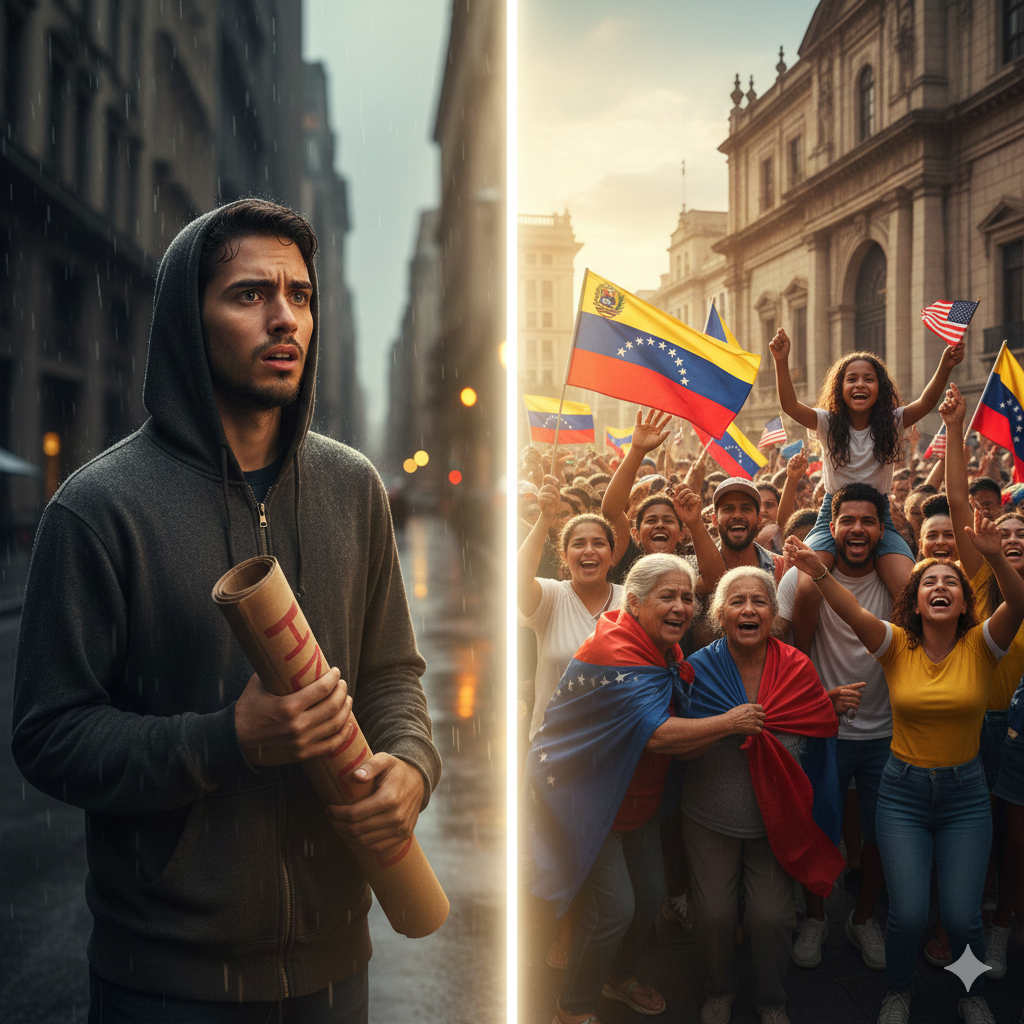
I want you to picture a scene from this very week. A young man stands on a street corner, fueled by a sense of justice and holding a sign in protest. He has spent years in classrooms and online forums being taught a specific narrative: that certain ideologies are the only path to equality, and that any intervention by the West is inherently evil. To him, the news of the U.S. military actions in Venezuela was a clear-cut case of “imperialism.” He believed he was standing for the oppressed.
But then, a moment of startling clarity occurred. Someone held up a phone and showed him a live feed from the streets of Caracas. He didn’t see a population cowering in fear. He saw grandmothers weeping with joy. He saw fathers hoisting their children onto their shoulders, waving flags, and shouting “Gracias” toward the sky. He saw a people who had been starving and silenced finally feeling the first breath of liberty.
The look on that young man’s face was one of total disorientation. In an instant, his “tradition”—the political and social narrative he had built his identity on—collided with the raw, human reality of the people he claimed to care about. He was doing what he was taught was good, but the people living the experience told a completely different story.
The Current Event: The Venezuelan Awakening
As we watch the events of January 3rd and 4th, 2026, unfold, we are seeing more than just a military shift; we are seeing a narrative shift. For years, many have debated the “merits” of the Venezuelan system from the comfort of homes with full pantries. But as the regime falls and the people speak, we are reminded that political theories are cold comfort to a mother who cannot find medicine for her child.
The “tradition” of modern ideology often prioritizes the system over the soul. We run the risk of viewing human lives through a lens of theory rather than looking at the faces of those being impacted. We can become so committed to our “protest” that we fail to join in the “celebration” of those finally set free.
— Mark 7:9 (MEV)
The Heart vs. The System
This tension isn’t new. Jesus faced it every day with the religious elite of His time. The Pharisees were “experts” in their ideologies. They had a system for everything—rules about who was “clean” and who was “unclean.” Their political and religious narrative allowed them to feel righteous while completely ignoring the suffering of the person right in front of them.
Think of the Parable of the Good Samaritan in Luke 10. The Priest and the Levite who walked past the bleeding man weren’t necessarily “villains” in their own minds. They were following their “tradition.” Their rules told them that touching a bloody, half-dead man would make them “unclean” for their religious duties. Their ideology of holiness actually prevented them from practicing actual holiness.
They were so busy being “correct” according to their system that they were useless to the man in the ditch. It was the Samaritan—the one who didn’t fit their narrative—who saw the human need and acted with the heart of the Father.
Reflecting This Week
- Check Your Lens: Are there “traditions” or political narratives I hold so tightly that I ignore the actual testimony of those suffering?
- People Over Policy: Do I see people as individuals made in the image of God, or merely as categories in a social theory?
- The Courage to Change: If the Holy Spirit shows me that my “goodness” is actually based on a lie, do I have the humility to change my mind?
The commandment of God is simple: Love God and love your neighbor. If our “traditions” prevent us from rejoicing when the oppressed are set free, then we have traded the Truth for a system. Let us be a people who look at the fruit, listen to the people, and follow the Spirit of Truth over the traditions of men.
Prayer: Lord, give us eyes to see beyond the narratives of this world. We pray for the people of Venezuela—that this physical liberation would lead to a spiritual awakening. Break our hearts for what breaks Yours, and help us to always prioritize the person over the policy. In Jesus’ name, Amen.